Faculty Bargaining Bulletin: Vol. 9, No. 7
October 6, 2026
May 7th, 2026
This page provides an overview of our bargaining process. Whether you are a Member looking to stay informed, a student wondering how negotiations impact your studies, or an interested party seeking to understand how union negotiations work, this page will walk you through each stage from start to finish.
The Ontario Labour Relations Act prescribes a sequence of potential stages for collective bargaining. Each of these phases serves a specific purpose, and the chart below is designed to illustrate how they connect.
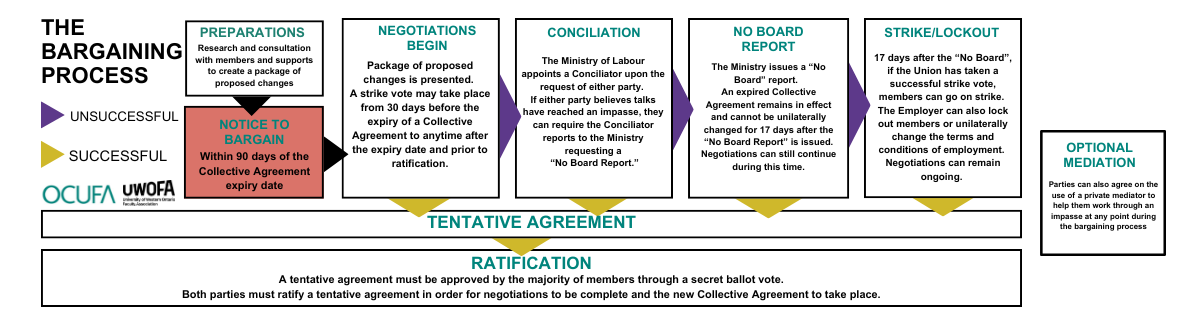
Preparations mark the beginning of the process, during which we consult with Members and develop proposals based on identified priorities. Our bargaining goals were brought forward to the Board and Membership for approval, and Members voted in favour of the bargaining goals this spring. This is followed by Notice to Bargain, which formally initiates the bargaining process and obligates both parties to meet and bargain in good faith. This step has now been completed and once bargaining dates are confirmed they will be shared with the membership.
The process then moves into Negotiations where proposals are presented by the Union and the Employer and discussed at the table. If agreement is reached, a Tentative Agreement is brought to each party for ratification. For UWOFA Members this means a Ratification Vote, For the Employer, the agreement is brought to the Board of Governors. Both parties must ratify the agreement for it to take effect.
If agreement is not reached, several structured steps exist to support resolution. Conciliation involves a government-appointed third party who works with both sides to help reach a settlement. If conciliation is not successful, either party may request a No Board Report from the Ministry, which once issued begins a defined 17-day period where negotiations can continue. At the end of the 17 days if an agreement is not reached, a legal Strike or Lockout becomes possible. Mediation may also be used at various points throughout the process to help move discussions forward.
At this stage, we are moving towards active negotiations. Our chief negotiator and deputy chief negotiator will meet with employer representatives in May to focus on housekeeping which addresses issues of an editorial nature in the collective agreement. For this round, the employer has agreed with our suggestion that we also discuss some substantive items related to the administration of the collective agreement in these discussions.
For the latest bargaining dates, process updates, and key developments, visit our Faculty Negotiations 2026 page, where we will post regular updates to keep members and the broader public informed throughout the process.